
-
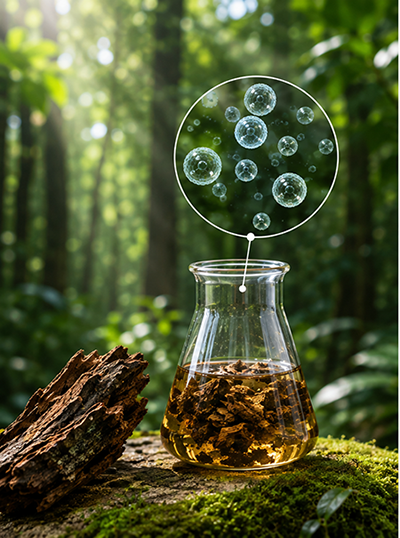
Agarwood: A Treasure Left Behind When Plants Get Injured
Many people believe agarwood is a specific species of tree. In reality, it is more accurately described as "wood formed after injury."
Agarwood primarily originates from plants in the Aquilaria genus of the Thymelaeaceae family. When these trees are damaged by insect feeding, fungal infection, or other external trauma, they activate a defense mechanism and secrete resin to repair the wound. Over years of accumulation, this resin-rich wood becomes agarwood. Thus, agarwood can be viewed as a plant's "defense record" left behind after enduring adversity. It is rich in natural active compounds such as sesquiterpenes, chromones, and flavonoids, which is why it has long been utilized in fragrances and traditional medicine.
In recent years, however, scientists have begun shifting their focus from standard "agarwood extracts" toward an even tinier protagonist:plant extracellular vesicles (PEVs).
-
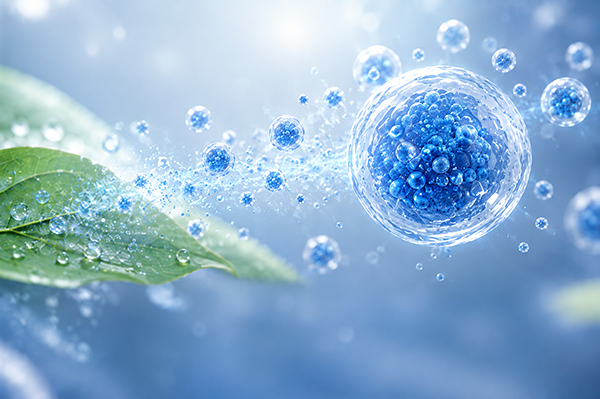
What are Plant Extracellular Vesicles ?
Recent research reveals that plants are not merely sources of natural active ingredients; their cells also secrete numerous tiny "nanovesicles." Measuring roughly 30 to 150 nanometers in size, these extracellular vesicles encapsulate proteins, lipids, RNA, and various natural metabolites inside. They participate in intercellular communication and can even exert biological effects on animal cells. Consequently, plant extracellular vesicles (PEVs) have progressively become a major focus of research in regenerative medicine, drug delivery, and natural health.
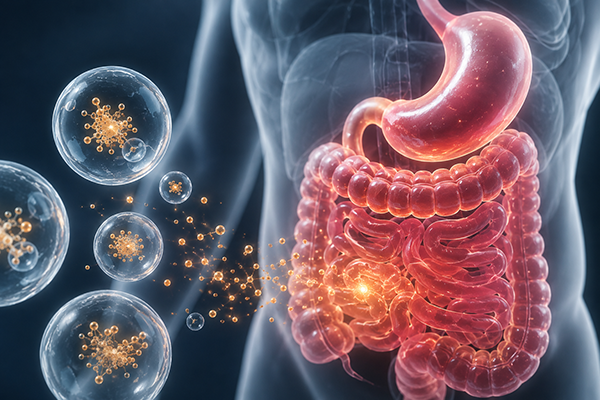
A recent study published in MedComm discovered for the first time that agarwood-derived exosome-like nanoparticles (ELNs) can effectively alleviate hypoxia-induced gastrointestinal injury. By successfully pinpointing key active components within them, the study opens up new possibilities for the application of plant extracellular vesicles.
-
Research Finding: Agarwood Extracellular Vesicles Alleviate Hypoxia-Induced Gastrointestinal Injury
In this study, the research team first successfully isolated exosome-like nanoparticles from agarwood, confirming a particle size of approximately 146 nanometers, which aligns with the typical characteristics of plant extracellular vesicles.
Next, the researchers established a hypoxia animal model to observe the gastrointestinal protective effects of agarwood extracellular vesicles.
The results revealed that mice receiving agarwood extracellular vesicles exhibited significantly reduced damage to their gastric and small intestinal mucosa, better-maintained gastrointestinal architecture, and notable improvements in symptoms such as weight loss and gastrointestinal bleeding.
Further compositional analysis revealed that agarwood extracellular vesicles are rich in a natural compound called ipriflavone. This compound regulates the PHD2/HIF-α signaling pathway associated with hypoxia responses, reduces cellular oxidative stress, and decreases lipid peroxidation. Consequently, it inhibits cell death and ultimately exerts a protective effect on the gastric and small intestinal mucosa - offering a promising new direction for future therapies targeting hypoxia-related conditions.
Application Prospects of Plant Extracellular Vesicles
Because plants are abundant and relatively easy to source—and naturally carry active molecules—numerous studies are currently exploring the application of plant extracellular vesicles (PEVs) in areas such as skin repair, chronic inflammation, gut health, and regenerative medicine. This research not only confirms the potential of agarwood extracellular vesicles to protect the gastrointestinal tract under hypoxic conditions, but it also identifies key active components and likely mechanisms of action, highlighting the promise of PEVs in regenerative medicine once again.
As research continues to build, plant extracellular vesicles may prove to be far more than just a biological discovery. In the future, they could evolve into a next-generation platform that combines natural active compounds with nanodelivery technologies, driving further innovation across the healthcare, medical, and biotechnology industries.
In the past, agarwood was renowned for its precious fragrance and medicinal value. Today, scientists are rediscovering it from a whole new perspective—focusing not just on its resin, but on the nano-sized extracellular vesicles secreted by its plant cells.
[Tomo Yume Bio-Tech] Translation & Editorial Review
Source Citation:
Wang D, et al. Ipriflavone from Aquilaria malaccensis Lam. exosome-like nanoparticles targets prolyl hydroxylase domain protein 2 (PHD2) to enhance hypoxia-inducible factor-α (HIF-α) hydroxylation thereby alleviating hypoxia-induced gastrointestinal mucosal ferroptosis. MedComm. 2026.
